Wednesday, March 11, 2009
Wang Qingsong's "Dormitory"
Read Full Post
Tuesday, March 10, 2009
Book Review Binge This Week
The Last Days of Old Beijing: Life in the Vanishing Backstreets of a City Transformed, by Michael Meyer. Walker, 355 pp., $25.99
Out of Mao's Shadow: The Struggle for the Soul of a New China, by
Philip P. Pan. Simon and Schuster, 349 pp., $28.00
Serve the People: A Stir-Fried Journey Through China, by Jen Lin-Liu. Harcourt, 341 pp., $24.00
IN THE NYTIMES SUNDAY BOOK REVIEW
By YU HUA, Reviewed by JESS ROW
A popular Chinese epic about growing up during the Cultural Revolution and chasing love and fortune in the new market economy.
First Chapter Sunday Magazine: A Profile of Yu Hua
'The Vagrants'
By YIYUN LI, Reviewed by PICO IYER
Centered on the aftermath of a young woman’s execution in a desolate part of China in 1979, Yiyun Li’s grieving and unremitting first novel examines the costs and consequences of a society gone mad.
First Chapter
'China Witness: Voices From a Silent Generation'
By XINRAN, Reviewed by JOSHUA HAMMER
A Chinese journalist coaxes reminiscences out of Cultural Revolution survivors.
ALSO
Gish Jen, Yu Hua, Ha Jin, and some prominent translators will be talking in Cambridge Thrusday at 5:30, at the Northwest Building, 52 Oxford Street, B103.
Read Full Post
Sunday, March 8, 2009
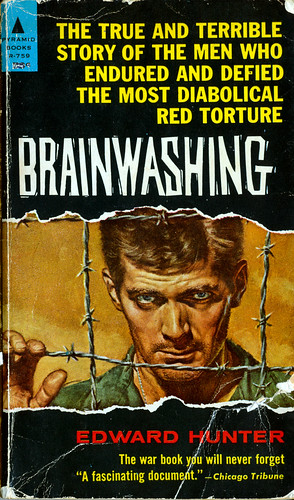
The Black Book on Red China, and the Origins of Brainwashing
Picked up a few books in front of the Cambridge post office today, including a copy of Sade's Dialogue Between a Priest and a Dying Man that turned out to be worth a bit - [my amateur antiquarian book hunting continues!] - but more directly relevant to the blog, there was a review copy of The Black Book on Red China, written in 1958 by Edward Hunter for The Committee of One Million, which protested the admission of China into the UN quite successfully for nearly two decades.
"The term xǐ năo (洗腦, the Chinese term literally translated as "to wash the brain") originally referred to methodologies of coercive persuasion used in the "reconstruction" (改造 gǎi zào) of the so-called feudal (封建 fēng jiàn) thought-patterns of Chinese citizens raised under pre-revolutionary régimes; the term punned on the Taoist custom of "cleansing/washing the heart" (洗心 xǐ xīn) prior to conducting certain ceremonies or entering certain holy places, and in Chinese, the word "心" xīn also refers to the soul or the mind, contrasting with the brain. The term first came into general use in the United States in the 1950s during the Korean War (1950–1953) to describe those same methods as applied by the Chinese communists to attempt deep and permanent behavioral changes in foreign prisoners, and especially during the Korean War to disrupt the ability of captured United Nations troops to effectively organize and resist their imprisonment. The word brainwashing consequently came into use in the United States of America to explain why, unlike in earlier wars, a relatively high percentage of American GIs defected to the enemy side after becoming prisoners-of-war in Korea."
Read Full Post
Friday, March 6, 2009
Reconstruction, the Mississippi, and the Orient
I: Missouri and China
Came across a fun article - "From the Midwest to the Far East" - tracing early connections between my homestead, Missouri, and the happy Orient. Connections range from exceptionally sad (The "New Shanghai Theater" in Branson) to ambiguously "good" (MO Born Edgar Snow, Red Star Over China.)
Excerpt of interest:
"The originator of the lineage can even be said to be none other than Mark Twain,the first Show Me State citizen to gain global renown as an author. Though henever made it to China on his travels, Twain was fascinated by the country, andhe wrote everything from an epistolary tale about a Chinese immigrant(“Goldsmith's Friend Abroad Again”), to a newspaper editorial denouncing the“unequal treaties” that the West had forced upon the Qing Dynasty (1644-1911) inthe mid-1800s, to essays sympathetic to the anti-Christian Boxer insurgents(since, in his mind, any foes of missionaries couldn't be all bad).
I hadn't been familiar with any of these pieces, and will be digging through soon.
I add one, the newest development - the midwestern hub for Chinese airlines will be, yes, drumroll, St. Louis! Who knows what the long term economic consequences of this corn-field diplomacy will be - for now, I expect the plans to create a veritable Chinatown on Olive will get fast tracked. Also, please imagine Chinese Ambassador Zhou Wenzhong, Kit Bond, and Claire McCaskill on the BEIJING-ST.LOUIS Hub Commission.
II. EQUAL TREATIES
Just got this in the mail, will try to go.
"For the Equality of Men---For the Equality of Nations": Anson Burlingame and China's First Embassy to the United States John Schrecker, Professor of History Emeritus, Brandeis University, and Associate in Research, Fairbank CenterIn 1861,
President Lincoln appointed Anson Burlingame, an anti-slavery leader, minister to China. After Burlingame had served in the post forsix years, Beijing selected him as its first ambassador to the Westernpowers. The Burlingame Mission came to America in 1868. The talk willfocus on (1) how the politics of reconstruction determined attitudestoward the mission; (2) Burlingame's presentation of China as a nationthat wished to be treated equally, was modernizing, and could both learn from and teach the West; and (3) the famous Burlingame Treaty with America---the first equal treaty between China and a Western power since the Opium War."
III. TWAIN AGAIN
Twain to Burlingame in 1868 [Citation and more on the friendship here]
"Don't neglect or refuse to keep a gorgeous secretaryship or a high interpretership for me in your great embassy... I would like to go with your embassy as a dignitary of some kind or other... I want to be a mild sort of dignitary... Pray save me a place."
III. FINAL WORD
"....with God's help we will lift Shanghai up and up, ever up, until it is just like Kansas City.” -Attributed to Senator Kenneth Wherry (R-Nebraska) 1940, though reliable citations seem yet to be found.
Read Full Post
Wednesday, March 4, 2009
"You commie homo-loving sons of guns"
It’s quite possible that the subtitler didn’t understand what Sean Penn had said and didn’t have time to find out. But supposing he/she did understand. Imagine you’re this poor CCTV employee and your ultimate boss is a senior member of the politburo. You’ve got very little time to decide what to do with a phrase that links communism with “homo-loving.” Your decision may not be appreciated by the leaders. OK, just make something up. [via Black and White Cat]
Read Full Post