Saturday, March 21, 2009

Dramatic Capital - 戏剧资本论 - and other incarnations of Das Kapital

So Danwei had a brief feature about a new (not the first) attempt to bring Das Kapital onto the stage. Snaps of the original article on Sina were translated as such: 

"To director He Nian, Das Kapital and the theory of surplus value are serious issues, yet he wants to make them fun to watch. He will set the play in a business. In the first half of the story, the employees discover that their boss is exploiting them and learn of the "surplus theory of value." However, they react differently to the knowledge of their exploitation: some are willing to be exploited by the company, and the tighter they are squeezed, the more they feel they are worth. Others rise in mutiny, but this ruins the company and leaves them out of work. Still others band together and use their collective wisdom to deal with the boss....He Nian said that due to the different points of view held by the boss and the workers, he would borrow the structure of Rashomon to show things repeatedly from different viewpoints."

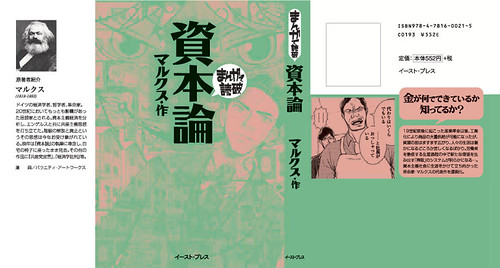
Above and around are images from the Japanese manga adaptation mentioned too, released just winter of last year - see coverage at Japan Probe, the Times, a blog titled "Hungry for Words", and Rachel Maddow

How will the elements collide?


Read Full Post

Tuesday, March 17, 2009

Science and Chinese Secularism

Wanted to just post a few thoughts on the review of the Joseph Needham biography by Eric Hobsbawm in the London Review of Books. [Caution - I've not read Winchester's book or Needham's Science and Civilisation.]

Much of the review focused on the intellectual richness layered around the natural sciences during Needham's time and place - Cambridge, the 1930s. Not merely "A Man Who Loved China," Hobsbawn seems to say, Needham's project revolved around a dialectical materialism that had melded into materialism proper ("organic Marxism"), and a fascination with the seemingly casual monism of Chinese cosmologies. From the article:

The whole organism, [Needham] argued, could not be fully grasped at any one of the lower levels of increasing size and complexity – the molecular, macromolecular, cells, tissues etc – and new modes of behaviour emerged at each level which could not be interpreted adequately in terms of those below or at all, except in their relations. As he wrote in Order and Life, ‘The hierarchy of relations from the molecular structure of carbon to the equilibrium of the species and the ecological whole, will perhaps be the leading idea of the future.’ Process, hierarchy and interaction were the key to a reality that could be understood only as a complex whole.

And – though one would not discover this from Winchester’s book – thisview drew him towards the country and civilisation to which he devoted the rest of his life. China was the dialectical home of Yin and Yang, of an ‘extreme disinclination to separate spirit and matter’, as Needham put it, of a philosophy which, it has been well said, saw the cosmos as a vast symphony that composed itself and within which other lesser symphonies took shape.

[...] Needham loved and admired China and the Chinese but, oddly, his heart went out to the imperial past rather than to the revolutionary present to which he was committed and which he defended (though he seems to have become a critic of Mao’s policies in the 1970s, even before the death of the Great Helmsman). He felt at home not only with the Chinese view of nature so lovingly reconstructed in Science and Civilisation in China but with a civilisation based on morality without supernaturalism, a great culture where the doctrine of original sin didn’t prevail and a country where no priesthood had ever dominated.

[Above, an image from a chapter in Needham's book on "Civil Engineering and Nautics."]

This brought to mind a few posts I'd seen on one of the many interesting SSRN blogs, "The Immanent Frame" (which largely is an expanding set of commentary revolving around Charles Taylor's The Secular Age. Disenchanting, ey?). Three posts by Richard Madsen (UCSD, Sociology) on Chinese secularism were very interesting , but I wasn't quite sure what to make of them (all drawn from a forthcoming chapter in a SSRN edited volume.) Examples of statements that I didn't feel like I agreed with but didn't have a basis for objecting to: 

Discerning the religious spirit of secular states in Asia
"But the secular form of Asian political institutions often masks a religious spirit. Some examples: Japan has a secular constitution, but many of its government leaders have felt compelled to pray for the spirits of the war dead at the Yasakuni shrine." 

Embedded religion in Asia

"However, this dynamism is of a different kind than that found in the United 

States, and it cannot be explained in terms of the narrative Taylor uses in the North Atlantic world.

 Asian religious developments are often misread by both Western observers and Asian scholars trained in the Western social sciences. When Western scholars have looked for religion in Asian societies, they have often looked for it in the form of private faith. But in most Asian societies, much of religion is neither private nor faith."

Hybrid consciousness or purified religion
"Taiwan’s state has taken a secular turn with democratization, but it still relies on religion to provide public stability and generate international recognition."

My quips probably lie with the analytical categories at play, and their usefulness - measuring degrees of embeddedness also, in some way or another, forces one to gauge the veracity and typology of belief. Embeddedness, in this context, may be a way of expressing what Needham had seen - a tendency not to see "spirit and matter" as radically separated, thus rendering secularism a somewhat sterile concept, a matter of institutions and practices rather than belief. Food for thought, in either case. 

Other articles of interest:
"The Public Sphere, Civil Society, and Moral Community: A Research Agenda for Contemporary China Studies", Modern China 19:10 (April, 1993).

"The Spiritual Crisis of China's Intellectuals" in Ezra Vogel and Deborah Davis, ed. The Social Consequences of the Chinese Reforms (Harvard University, 1991)

Also, I had seen that Du Shu magazine (Readings) had, in their June-August 1995 editions, played out a series of essays under the title "Why Not Collectively Build a Spiritual Homeland?" Perhaps of interest. 
Read Full Post

Monday, March 16, 2009

Little Reunion (小团圆) - Eileen Chang


Roland Soong's amazing blog EastSouthWestNorth has recently been jammed up due to a considerably large event - the publication of a posthumous, autobiographical manuscript of Eileen Chang's. (Free international shipping of the volume on YesAsia - what YesAsia is, I'm not quite sure. )

According to his recent post, it's already gone through FIVE PRINTINGS in the last month since its release in HK and Taiwan. 

I first discovered Soong was the executer of her literary estate when I came across these archives of letters, commentary, and other resources when I was doing dinky research for my dinky project on Ang Lee. It seemed like a funny venue to be discovering these (I wondered why I wasn't stumbling into NTU or HKU's websites), and the rich and luminous commentary was a welcome medium of transfer.  A sort of sad and hilarious passage he's recently translated on Lust, Caution (which apparently contains a number of factual mistakes, esp - the story was shipped to Roland Soong's father, not the poor publishing house manager described.)
At the cocktail party for the Taipei premiere of . I saw my old friend Kao Hsin-chiang come in. I asked him what he came. He said that his son Kao Ying-hsien had a role in the film (as the chauffeur and landlord) and therefore he came from Beijing to attend this premiers. I told him that I have a series of essays critical of which United Daily published without my permission. He said that his wife showed him the clippings as soon as he came back. His wife is a devout Christian who read the essays and she "promised to close her eyes and pray whenever there is any sexy scene during the movie."

I said: "You're the one who created the problem." I object to because of the story. It is based upon an Eileen Chang novel published while Kao Hsin-chiang was the chief editor of the China Times supplement section.

Kao Hsin-chiang said: "Chang's story was turned over to me in 1978 by the Hong Kong literary expert Tang Wen-piao. Tang is the initiator of the Eileen Chang craze and edited the published by China Times. When Eileen Chang saw the book in the United States, she was very angry because she felt that Tang had violated her intellectual property rights. So China Times had to stop distribution. In June 1985, the China Times Publishing House general manager called Tang Wen-piao in Taichung and told him that there were 400 more copies of the book in the warehouse. 'If you like, I will rent a van and shipped them over to you; if not, I will destroy them.' Tang said that he wanted them. So the driver brought the books over to the door of his house, and Tang had to carry them to his first-floor apartment by himself. Tang had nasopharyngeal cancer for years already, and the effort caused him to bleed to death. A friend in the Taipei literary circle cried when he learned the news: 'Sigh, Tang Wen-piao, you loved Eileen Chang to death!' In modern literary history, Tang is the only person who died as a result of loving Eileen Chang."

Of those I have read, one of my favorite posts on his Eileen Chang blog is on her bilingualism, with one tracing a discovered English language version of her essay, "A Return to the Frontier", chronicling a trip to Taiwan in 1961, and an expanded Chinese version, and another English story "Stale Mates." A second contains three English to Chinese translations of Thoreau poems, and a Chinese version of an introduction she wrote on Thoreau in a compilation of American poetry translations. 

And a last treat I found last night was a flash feature in Tofu Magazine ("mini-tofu no. 6") that plays with Eileen Chang's drawings. 

And above, a painting by Chinese artist Liu Ye, of the writer ("Zhang Ailing"), which auctioned off at $34 USD.

Read Full Post

Sunday, March 15, 2009

Shibboleths of the The Gowned Brotherhood

Reading an article by Texas A&M Professor Di Wang, "Mysterious Communication: The Secret Language of the Gowned Brotherhood in Nineteenth-Century Sichuan", tracing the specialized code-switching of one anti-Manchu/Qing secret society (published in the June 2008 ed. of Late Imperial China.)  BRS had stumbled on to Di Wang's book on street culture in Chengdu, and we became engrossed in his faculty page.

One practice described is clandestine tea-ware arrangement paired with recitation of poetry - the graphic below, from the paper, illustrates a few for the budding revolutionary. A sample exchange may proceed as Wang describes:
If a member went to another lodge to ask for help, he would set up a “single whip formation” (danbian zhen), a teacup facing the mouth of a small teapot. If the host agreed to offer help, he would drink the cup  of tea; if not, he would spill the tea on the ground and then pour new tea into the cup, drink it, and recite the poem, “A whipping horseman is running on the horizon, / Who’ll clear all clouds and come here alone. / Changing golden dragon shows fortune / And help our lord mount the throne.”(Wang 92)

William Stanton's The Triad Society or Heaven and Earth Association, full text online via Google Books, describes some of the other interactions you may see between lodge brothers loafing in wait for one another in the teahouse:
“Why is your hair so unkempt?/I was born under a peach tree”; “Why is your hair so ruffled?/I have been to extinguish a fire”; “Why is your hair so wet?/I have not long been born”; “Why has your hair got so many cobwebs in it?/They are not cobwebs, but five-colored silk.”

Read Full Post

Thursday, March 12, 2009

Euro(trash) Book Marketing

So BRS had mentioned to me a funny book marketing escapade of Time reporter Alex Perry, who had his book, Falling off the Edge: Travels Through the Dark Heart of Globalization, sell modestly here and fairly well in Europe (where the subheader was changed to "Globalization, World Peace, and Other Lies.) The book cover contrast is pretty amazing, along the same lines, he pointed out: cosmopolitan, safe, in the Thomas Friedman genre here, and dystopic, furious, in the Guy Debord genre there. 

Now below note the same phenomenon with Simon Winchester's recent book, in the UK titled Bomb, Book and Compass: Joseph Needham and the Great Secrets of China, and in the US, titled The Man Who Loved China: The Fantastic Story of the Eccentric Scientist Who Unlocked the Mysteries of the Middle Kingdom. [Cool review in LRB by Eric Hobsbawm! here.]
Almost as amazing as the transformation of the Rock into "a down-on-his-luck cabdriver who inherits the super twins as his magical fare."


Read Full Post