Tuesday, March 31, 2009

Cigarette Cards and Opera Masks

Waylaid without excuse (attempts: HBO, escalation of stress at work, Bonfire of the Vanities), but here are some cigarette cards from the New York Public Library's collection. The norm of including one of these tradable card series in cigarette packages was a gimmick thought up be James B. Duke in the late 1870s - I tried to dig around (lazily, albeit) but couldn't figure out the first appearances in China, where (I imagine) they must have represented some of those creeping innovations in modern advertising born from more familiar comic-like art (incursion of an internationally tradable unit of graphic design, or something of the sort.) Zhou Xun traces a cultural history of smoking during the early 20th C. in Smoke (one can never have enough cultural histories of single commodities, except, when one has had enough.)

PS
Doing research for Joyce Chaplin, J. Specht discovered a highlight of American cigarette slogans in the 50's: "Blow on her face, and she'll follow you anywhere."

Chinese opera faces (masks) Digital ID: 1184032. New York Public Library
Chinese opera faces (masks) Digital ID: 1183876. New York Public Library
Chinese opera faces (masks) Digital ID: 1183890. New York Public Library


Read Full Post

Sunday, March 29, 2009

"Who After Mao" Foreign Affairs 1973

Also, blast back to the Cold War. From a Foreign Affairs article, "Who After Mao," Mark Gayn, Jan. 1973;

The great hurrahs of the Cultural Revolution, the slogans, the messianic fervor, the public humiliation of the heretics are all gone. A visitor to Peking is impressed by nothing so much as by the return to normalcy, by pragmatism and-if one could imagine it in a Spartan land-a feeling of relaxation. Indeed, one might easily think that there had never been the awesome upheaval of 1966-69 "to change men's souls." Human frailty is once again understood, and there is at least an implied recognition that man does not live by faith alone.


Read Full Post

Friday, March 27, 2009

Sino-African "Relations" - The Chafrica Epic Continues

The string of stories about Chinese investments in Africa that began to perculote out three years ago into the mainstream media continues. Yesterday's story in the NYT, "As Chinese Investment in Africa Drops, Hope Sinks,"describes the usual hawkish investment tactics of Chinese companies waning in the crisis (Breakoff from a major hydroelectric dam project in Guinea was the center of the story.) Photos (which revolve around Jinya Group employees, it looks), here.

Stefan R. Landsberger at Leiden University, The Netherlands, has quite a collection of propaganda available online (most published in a book Chinese Propaganda Posters—From Revolution to Modernization). One page of his site deals particularly with representation of Africans in early PRC materials (posters Landsbergers' scans)- from Landsberger:


"The appearance of colored peoples, and blacks in particular, in Chinese propaganda posters always has been problematic. Before the CCP grasped power, the only attention devoted to colored peoples in Chinese art was of a negative tone. Once the PRC was established, however, this attitude changed. Now that racial problems were seen as class problems, China increasingly discovered similarities between its own traumatic experiences with ‘white imperialism’ and those of other victimized ‘colored’ people in the world. It was time to downplay the traditional and deeply ingrained feelings of superiority. One of the first official steps to gain credibility as a supporter of the oppressed was taken in September 1950, when the Chinese lodged an official protest against the policy of apartheid in South Africa. Africans soon became regular guests in Beijing, where they were entertained at parties and met with the highest state leaders. By the late 1950s, many delegations had passed through Beijing and Zhongnanhai. But the Chinese did not actively spread the gospel of revolution and national liberation yet. They merely positioned themselves as a model that needed to be followed to gain independence."

So thus from the international struggle for rights to the neoliberal imperial clamour.

Related:
Evan Osnos in the New Yorker on Guangzhou's Canaan Market and African merchants -"Nigeriatown" (Audio Slideshow) and "The Promised Land"


And a from "the ground" article translated from the Southern Metropolis Daily: "“Chocolate City” - Africans seek their dreams in China"

And lastly, a story that (I think? Perhaps I was off the beat) was not on the radar of mainstream media during the Olympics as much but was a buzz on the blogosphere - police allegedly told bars to not serve "black people or Mongolians." (Original Shanghaiist piece.)

Later reports contended that "black" may have meant triad members (literally the "black society") - "Mongolians" had few homonyms to fall back on.

Read Full Post

Saturday, March 21, 2009

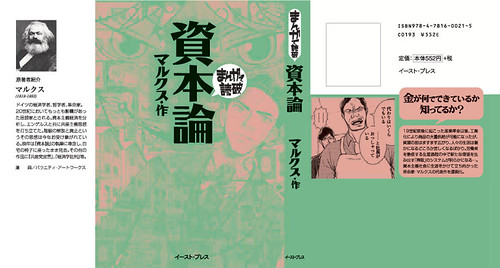
Dramatic Capital - 戏剧资本论 - and other incarnations of Das Kapital

So Danwei had a brief feature about a new (not the first) attempt to bring Das Kapital onto the stage. Snaps of the original article on Sina were translated as such: 

"To director He Nian, Das Kapital and the theory of surplus value are serious issues, yet he wants to make them fun to watch. He will set the play in a business. In the first half of the story, the employees discover that their boss is exploiting them and learn of the "surplus theory of value." However, they react differently to the knowledge of their exploitation: some are willing to be exploited by the company, and the tighter they are squeezed, the more they feel they are worth. Others rise in mutiny, but this ruins the company and leaves them out of work. Still others band together and use their collective wisdom to deal with the boss....He Nian said that due to the different points of view held by the boss and the workers, he would borrow the structure of Rashomon to show things repeatedly from different viewpoints."

Above and around are images from the Japanese manga adaptation mentioned too, released just winter of last year - see coverage at Japan Probe, the Times, a blog titled "Hungry for Words", and Rachel Maddow

How will the elements collide?


Read Full Post

Tuesday, March 17, 2009

Science and Chinese Secularism

Wanted to just post a few thoughts on the review of the Joseph Needham biography by Eric Hobsbawm in the London Review of Books. [Caution - I've not read Winchester's book or Needham's Science and Civilisation.]

Much of the review focused on the intellectual richness layered around the natural sciences during Needham's time and place - Cambridge, the 1930s. Not merely "A Man Who Loved China," Hobsbawn seems to say, Needham's project revolved around a dialectical materialism that had melded into materialism proper ("organic Marxism"), and a fascination with the seemingly casual monism of Chinese cosmologies. From the article:

The whole organism, [Needham] argued, could not be fully grasped at any one of the lower levels of increasing size and complexity – the molecular, macromolecular, cells, tissues etc – and new modes of behaviour emerged at each level which could not be interpreted adequately in terms of those below or at all, except in their relations. As he wrote in Order and Life, ‘The hierarchy of relations from the molecular structure of carbon to the equilibrium of the species and the ecological whole, will perhaps be the leading idea of the future.’ Process, hierarchy and interaction were the key to a reality that could be understood only as a complex whole.

And – though one would not discover this from Winchester’s book – thisview drew him towards the country and civilisation to which he devoted the rest of his life. China was the dialectical home of Yin and Yang, of an ‘extreme disinclination to separate spirit and matter’, as Needham put it, of a philosophy which, it has been well said, saw the cosmos as a vast symphony that composed itself and within which other lesser symphonies took shape.

[...] Needham loved and admired China and the Chinese but, oddly, his heart went out to the imperial past rather than to the revolutionary present to which he was committed and which he defended (though he seems to have become a critic of Mao’s policies in the 1970s, even before the death of the Great Helmsman). He felt at home not only with the Chinese view of nature so lovingly reconstructed in Science and Civilisation in China but with a civilisation based on morality without supernaturalism, a great culture where the doctrine of original sin didn’t prevail and a country where no priesthood had ever dominated.

[Above, an image from a chapter in Needham's book on "Civil Engineering and Nautics."]

This brought to mind a few posts I'd seen on one of the many interesting SSRN blogs, "The Immanent Frame" (which largely is an expanding set of commentary revolving around Charles Taylor's The Secular Age. Disenchanting, ey?). Three posts by Richard Madsen (UCSD, Sociology) on Chinese secularism were very interesting , but I wasn't quite sure what to make of them (all drawn from a forthcoming chapter in a SSRN edited volume.) Examples of statements that I didn't feel like I agreed with but didn't have a basis for objecting to: 

Discerning the religious spirit of secular states in Asia
"But the secular form of Asian political institutions often masks a religious spirit. Some examples: Japan has a secular constitution, but many of its government leaders have felt compelled to pray for the spirits of the war dead at the Yasakuni shrine." 

Embedded religion in Asia

"However, this dynamism is of a different kind than that found in the United 

States, and it cannot be explained in terms of the narrative Taylor uses in the North Atlantic world.

 Asian religious developments are often misread by both Western observers and Asian scholars trained in the Western social sciences. When Western scholars have looked for religion in Asian societies, they have often looked for it in the form of private faith. But in most Asian societies, much of religion is neither private nor faith."

Hybrid consciousness or purified religion
"Taiwan’s state has taken a secular turn with democratization, but it still relies on religion to provide public stability and generate international recognition."

My quips probably lie with the analytical categories at play, and their usefulness - measuring degrees of embeddedness also, in some way or another, forces one to gauge the veracity and typology of belief. Embeddedness, in this context, may be a way of expressing what Needham had seen - a tendency not to see "spirit and matter" as radically separated, thus rendering secularism a somewhat sterile concept, a matter of institutions and practices rather than belief. Food for thought, in either case. 

Other articles of interest:
"The Public Sphere, Civil Society, and Moral Community: A Research Agenda for Contemporary China Studies", Modern China 19:10 (April, 1993).

"The Spiritual Crisis of China's Intellectuals" in Ezra Vogel and Deborah Davis, ed. The Social Consequences of the Chinese Reforms (Harvard University, 1991)

Also, I had seen that Du Shu magazine (Readings) had, in their June-August 1995 editions, played out a series of essays under the title "Why Not Collectively Build a Spiritual Homeland?" Perhaps of interest. 

Read Full Post