Tuesday, April 27, 2010

Revivification: Johnnie To

Weekly post-rate here finally leveled out to zero, so here's a brief set of ramblings

1. Exhausted Diligence has been battered by Chinese-language link posts in comments, which is simultaneously awesome and discouraging. In my very brief entertaining of the comparative structure of spam-botting, it does seem marginally better than some English counterparts, though (a) differences in labor structures could mean human spambots are cost effective, or (b) that grammatical ellision actually makes Chinese spam easier and perhaps French spam least believable or that (c) sheer numbers of native Chinese language spammers and users means that the evolutionary learning curve of the programs (which iterate themselves, at times, and obviously, are iterated by spam progenitors) has been more steep than the English. An easy answer is also that my English is superbly better than my Chinese.
2. Tumblr has been eating my online life, as a primary goal of this whole thing had been to more effectively bookmark my own readings and give a little structure to my Asia-web wandering. But that turned out to be so much better with a bookmarklet!


3. There has been a major Johnnie To kick in my household(s). And Johnnie To is producing Jia Zhang-ke's next film -- his first big-budget piece -- which both terrifies and intrigues me. But more importantly
via Paper Republic here is an old FBI guide by one agent Fritz Chang to Canto gang slang.
4. Two fantasy lives of intrigue -- photographer Jing Quek is looking for a production assistant, Imagine living the world he tags Jingapore (below), and getting coffee for it.


5. One of the articles that has stuck in my mind -- this is not arts -- is a recent piece by Steve Walt in Foreign Policy -- "China's New Strategy." I'm repelled in many ways by realism (rational-choice applied to IR, positing nation-states as black-boxes motivated solely by their "interests"), but the arguments he lays out rattled me. As he puts it

"On one side are realists who believe that if China continues to increase its economic power, then significant security competition between the two countries is virtually inevitable. On the other side are those (mostly liberal) theorists who believe that the potential for trouble will be muted by economic interdependence and the socializing effects of China's growing participation in various international institutions. (This was Bill Clinton's rationale for getting China into the World Trade Organization, for example). And if China were to make a gradual transition to democracy, so the argument runs, then democratic peace theory will kick in and there's nothing to worry about.

On Saturday, the New York Times published an important story supporting the realist view. It described the rapid expansion of China's naval capabilities (a classic manifestation of great power status), as well as the more ambitious new strategy that this growing capacity is designed to serve. Briefly, as China's economic power and dependence on overseas raw materials (e.g., oil) has grown, it is seeking to acquire the ability to protect its access. In practice, China's new strategy of "far sea defense" means acquiring the ability to project naval power into key ocean areas (including the Indian Ocean and Persian Gulf), while denying other naval powers the ability to operate with impunity in areas close to China."




Read Full Post

Wednesday, March 24, 2010

Google, Isaiah Berlin, Guobin Yang


I've been posting much to a
tumblr - EXCURSUS II -- for ease of access, esp. since the interface makes it easier to pop on links or images I find interesting during the course of the workday. While browsing the Social Science Research Council's mash of articles, I came across a great article on Google's projected China exit by Guobin Yang (one of the real academic leaders on the political implications of networked communications there.) "Why Google Should Not Quit" makes an interesting pivot on the ways in which the exit would shift both positive ("to do", capabilities) and negative freedom ("freedom from", non-interference) in the PRC, arguing that the censorship landscape would essentially not change (negative freedom won't be affected) BUT that the reduction in competitiveness may lead to a more impoverished internet landscape generally (reducing positive freedom.) he says:
"It is hard to imagine Google continuing to operate in China by censoring its search engine as if nothing had happened. But neither can I imagine Google retreating into its inner citadel. I find it unlikely, as Isaiah Berlin might put it, that when faced with two methods of freeing itself from the pain of a wounded leg, one of difficulty and uncertainty of finding a cure, the other of cutting it off, Google will opt for the second. Perhaps we will soon see another moment of Google creativity."
More potently, I do wonder whether this is the beginning of a great divergence in global information landscapes.


Read Full Post

Wednesday, March 3, 2010

1937

"Americans saw China as a great future trade partner and President Franklin Roosevelt himself had family business connections in China. Americans applauded the advances that American Christian missions seemed to be making in the country. China would one day be the United States of Asia: prosperous, Christian, and free."

-From Chris Bayly and Tim Harper. Forgotten Armies: The Fall of British Asia, 1941-1945.

Read Full Post

Monday, March 1, 2010

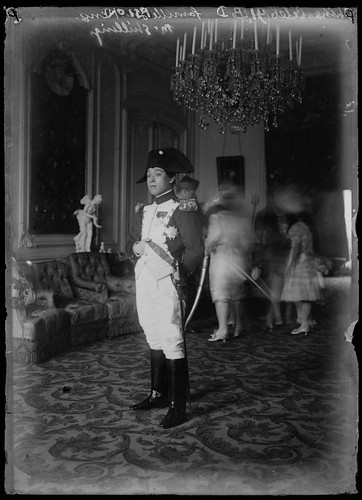
The Chinese Embassy in Paris, 1900

I was browsing The Commons on Flickr, where the Library of Congress and tons of other museums/collections have uploaded their public collections. There's a scant East-Asia related set, but I found this treasure in the George Eastman House Collection. Author of "Imperial Masquerade: The Legend of Princess Der Ling" a biography of the lady in waiting to Empress Dowager Cixi, explains in the comments that the boy striking the Napoleonic pose is in fact Xinling, member of the Manchu royal family and elder brother of the aforementioned Princess Der Ling. Chinese Embassy in Paris, taken around 1900.

PS: [I think I may be assaulting the RSS feed of this blog with false-starts on entries. Never again!]]]

Read Full Post

Friday, February 26, 2010

Yang Yang (b. 1969) -- 命题游戏之一 (?A Game of Fate Pt 1?)

What I thought was a striking piece from painter Yang Yang. Not much on her in English but I was really rapt by these baroque riffs on Botticelli that seem to run through her work. Some more of it here (a compendium of prominent female painters) and here (which has some bio information too.) It also rang a bell and then it struck me! Porcelain bust on cover of the NYRB ed. of Eileen Chang's "Love in a Fallen City."

Found after browsing Art Scene China's site -- they have I think one of the biggest showrooms in the 798 space, though I may be wrong. [[798 is a Bauhaus-era textile factory abandoned then transformed into the art district of Beijing. My lasting impression when I went -- via motorcycle the summer after my freshman year, due to some botched directions -- was some artist who was popping EEG headgear onto unwilling participants and asking them to use their beta-waves to paint lotuses with lasers on the warehouse floor.]]

Read Full Post