Showing posts with label photography. Show all posts

Thursday, February 10, 2011

Immaculate Hoardes: Visual Correlatives of Swarm Fear

A quick response to a post on [The China Beat] that caught a trend I've been meaning to post on for a while. Writes one T.S. Mullaney about Foreign Policy's recent "Rise of the Hans" feature:
Whoever at Foreign Policy thought of this image—in particular, thought of using the metaphor of clones—captured the essence of Kotkin’s argument flawlessly: the Han, we are meant to believe, is a singular mass of physically, politically, ideologically, socially, culturally, and linguistically indistinguishable replicas, one that brings to mind the clone troopers of Kamino in Star Wars or, perhaps, hive-like, sci-fi adversaries, such as the “Buggers” in Orson Scott Card’s Ender’s Trilogy, the Arachnids of planet Klendathu in Robert Heinlen’s Starship Troopers (who, incidentally, was writing in the aftermath of the Korean War and was also fascinated by the racist idea of an ego-less, self-less, and homogenous Asian adversary), or the Borg of Star Trek (a tendency that some commentators have explicitly used to refer to the PRC—something that one of the co-founders of China Beat criticized in a piece that appeared in Foreign Policy itself last year). Kotkin omits, or perhaps does not know, that the Han is one of the least homogenous groups history has ever known: contained within its ranks are people who literally cannot understand each other’s spoken languages and people who—let’s just be basic about this—exhibit the same sort of diversity of worldviews as one would expect to find among a group of one billion people anywhere on earth.
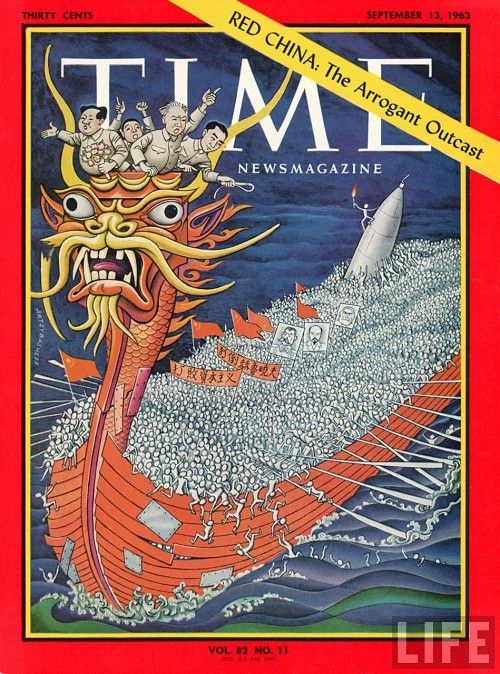
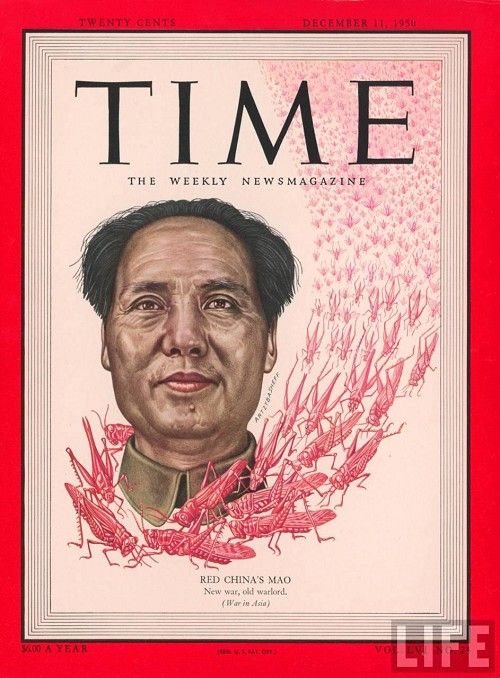
Let us call this discursive construct Neo-Borgian Yellow Peril, earlier images of which are exemplified by the two TIME covers below (locusts are 1950, teeming mass from 1963. From ChinaSMACK.) The mass, which in the early 20th century may have ridden very quickly on horses to invade America, but now ride very studiously on state-owned enterprises to invade world order. I am remiss in finding one particularly amazing image from the mid-1970s that depicts Mao as an aggregation of clamoring peasants and mandarins.

The Neo-Borgian Cloud has in fact been a trend in the visual representation of many Chinese events since the Olympics (see images below).The eeriness comes from a post-processing that invariably sharpens digital images, heightens color and smooths noise to convey that squeaky gleam of capitalist modernism - and a simultaneous proclivity for compositions that capture seemingly boundless duplication (ie terror of scale), immaculate repetition (ie terror of forced homogeneity) that projects the power of an authoritarian state.This is not to say that there is not a desire to project this very image of state power.
There is likely a good term for this. Perhaps it exists already in the fecund world of art criticism. I suggest militaristic hyper-modernism.


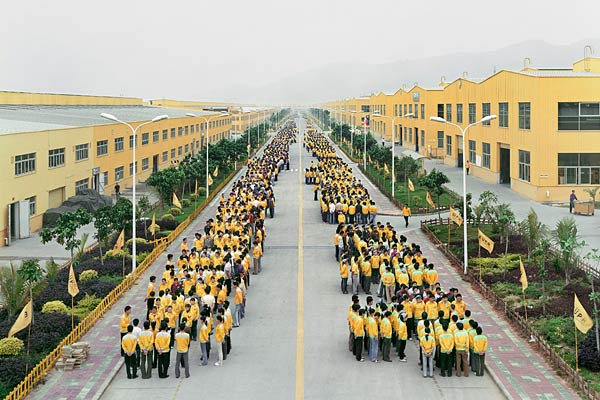
 From various sources, two shots from Olympic opening ceremonies, security exercise outside of the Bird's Nest, laborers outside of their factory and students preparing for exams. 


Read Full Post

Tuesday, April 27, 2010

Revivification: Johnnie To

Weekly post-rate here finally leveled out to zero, so here's a brief set of ramblings

1. Exhausted Diligence has been battered by Chinese-language link posts in comments, which is simultaneously awesome and discouraging. In my very brief entertaining of the comparative structure of spam-botting, it does seem marginally better than some English counterparts, though (a) differences in labor structures could mean human spambots are cost effective, or (b) that grammatical ellision actually makes Chinese spam easier and perhaps French spam least believable or that (c) sheer numbers of native Chinese language spammers and users means that the evolutionary learning curve of the programs (which iterate themselves, at times, and obviously, are iterated by spam progenitors) has been more steep than the English. An easy answer is also that my English is superbly better than my Chinese.
2. Tumblr has been eating my online life, as a primary goal of this whole thing had been to more effectively bookmark my own readings and give a little structure to my Asia-web wandering. But that turned out to be so much better with a bookmarklet!


3. There has been a major Johnnie To kick in my household(s). And Johnnie To is producing Jia Zhang-ke's next film -- his first big-budget piece -- which both terrifies and intrigues me. But more importantly
via Paper Republic here is an old FBI guide by one agent Fritz Chang to Canto gang slang.
4. Two fantasy lives of intrigue -- photographer Jing Quek is looking for a production assistant, Imagine living the world he tags Jingapore (below), and getting coffee for it.


5. One of the articles that has stuck in my mind -- this is not arts -- is a recent piece by Steve Walt in Foreign Policy -- "China's New Strategy." I'm repelled in many ways by realism (rational-choice applied to IR, positing nation-states as black-boxes motivated solely by their "interests"), but the arguments he lays out rattled me. As he puts it

"On one side are realists who believe that if China continues to increase its economic power, then significant security competition between the two countries is virtually inevitable. On the other side are those (mostly liberal) theorists who believe that the potential for trouble will be muted by economic interdependence and the socializing effects of China's growing participation in various international institutions. (This was Bill Clinton's rationale for getting China into the World Trade Organization, for example). And if China were to make a gradual transition to democracy, so the argument runs, then democratic peace theory will kick in and there's nothing to worry about.

On Saturday, the New York Times published an important story supporting the realist view. It described the rapid expansion of China's naval capabilities (a classic manifestation of great power status), as well as the more ambitious new strategy that this growing capacity is designed to serve. Briefly, as China's economic power and dependence on overseas raw materials (e.g., oil) has grown, it is seeking to acquire the ability to protect its access. In practice, China's new strategy of "far sea defense" means acquiring the ability to project naval power into key ocean areas (including the Indian Ocean and Persian Gulf), while denying other naval powers the ability to operate with impunity in areas close to China."


Read Full Post

Monday, March 1, 2010

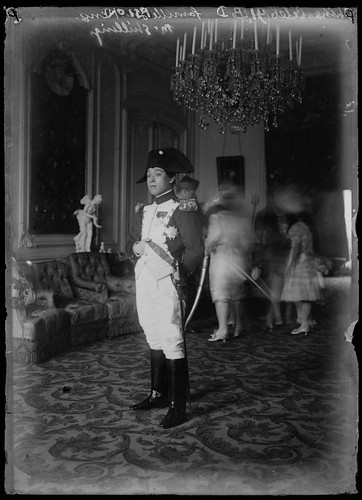
The Chinese Embassy in Paris, 1900

I was browsing The Commons on Flickr, where the Library of Congress and tons of other museums/collections have uploaded their public collections. There's a scant East-Asia related set, but I found this treasure in the George Eastman House Collection. Author of "Imperial Masquerade: The Legend of Princess Der Ling" a biography of the lady in waiting to Empress Dowager Cixi, explains in the comments that the boy striking the Napoleonic pose is in fact Xinling, member of the Manchu royal family and elder brother of the aforementioned Princess Der Ling. Chinese Embassy in Paris, taken around 1900.

PS: [I think I may be assaulting the RSS feed of this blog with false-starts on entries. Never again!]]]

Read Full Post

Saturday, June 13, 2009

Also, Politically Charged Sunburn


Also, via Danwei, via Ai Wei Wei's blog -  the artist protests through the double-movement of (skin) exposure and (sunscreen) omission.  Delicious. And another pleasant view below. Is he echoing the fullness of maternity in an act of ultimate, subversive empathy? Can the politburo be destroyed through the inversion of the signification of Ai Wei Wei's belly, jiggling nakedly into the eye of the patriach? Evan Osnos' profile of some of his US photos from a few months ago here. (Swoon.)


Read Full Post

Monday, June 8, 2009

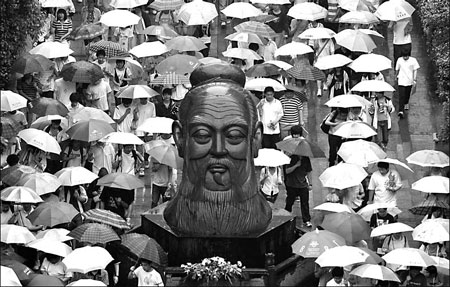
Gaokao Exodus in Wuhan

Great picture in the English People's Daily today: 


CAPTION: "University aspirants walk out of the No 6 High School in Wuhan, Hubei province, after finishing the morning session of their college entrance exam yesterday."

See, of course, ChinaSMACK's photos from the deluge here - much paperwork thrown onto the street.  One of my favorite articles on the madness of the entrance exams from Time, last year, here. 

Read Full Post

Wednesday, March 11, 2009

Wang Qingsong's "Dormitory"


The browser cannot contain its fully glory in this form. See Dormitory here   lso see his triptych  "Past, Present and Future" and  China Mansion - all bizarre and somewhat mesmerizing panoramic, staged tableaus. 

The movement of these from his earlier work is pretty phenomenal. See Adam and Eve (97?) left: 

From a 2004 NYT article, The Venus de China: 

"Mr. Wang has turned his own case of cultural whiplash into very large-scale photographs of dazzling beauty, present-day equivalents of history paintings packed with whimsical details and dramatic effects. ''Romantique'' (2003), measuring 4 feet by 21 feet, presents a garden of earthly delights -- orange groves, lush green grass, cobalt-blue sky -- filled with more than 50 live models, all Asian, re-enacting poses found in Western art history. On the far left are Michelangelo's Adam and Eve and the quartet from Manet's ''Déjeuner sur l'Herbe.'' In the center, Botticelli's Venus rises from her clamshell, surrounded by voluptuous bathers and lounging maidens reminiscent of paintings by Ingres, Velásquez, Matisse and Gauguin.

But off on her own at the far right, a nude woman sits in a rickshaw. She is a concoction not found in the Western canon, yet she stares directly at the audience with all the forcefulness of a modern-day Olympia. Her presence adds a cautionary note to this otherwise bucolic scene, a warning that the new China might not be simply a picturesque paradise ripe for exploitation by foreign investors or for total immersion in Western influences."


Read Full Post

Sunday, February 22, 2009

Wang Ningde (王宁德)- Interview Part I

Wang Ningde is one of my favorite contemporary photographers in China - perhaps not surprisingly, he spends most of his time as a photojournalist.

These are from his "Somedays" series, which has gotten play abroad - see the Goedhuis Contemporary on him, and this SF Camerawork piece. Taking a stab at translating sources on him - below is a choppy first take at the first portion of an interview with Chinese blogger Li Nan.

It's quite a bit longer - will upload the rest soon.


Wang Ningde’s Influences: My understanding of photography, from my contempt of it.
Guest: Wang Ningde
Moderator: Li Nan
Piece: Photographic Reproductions of The Mona Lisa

When I asked Wang Ningde “What differences do you sense, visually and in meaning, between the original and the reproductions of the image?” the photographer replied slyly: “ You’re analysis is quite adept - the question you’ve asked is the question I’d like to ask. You’d surely answer this question better than I might.” Of course, I wasn’t about to fall for that answer – what I was interested in, really, was the fact that this particular memory of a budding interest in photography is shared by many. I, for example, immediately think of the many beautiful hanging wall calendars I saw as a child, all reproducing famous works of art from the West. Photography is its own form of expression, yet at the same time, can serve merely as the medium for other forms, and in the process of pervasive transmission, the medium of representation becomes a part of the artwork itself.

Within the lively contemporary art scene, re-performance of classic works is a standard. In choosing to revisit such a masterpiece, Wang Ningde’s sensibilities seem “modernized” as well.

WANG NING DE

To be honest, it’s been something like five years since I read up on/studied any image. So, I can only revisit my childhood. Of course, I have to think about how to make this all sound a bit more exciting – I’ll be speaking of a photographer whose name I don’t even know.

I was born in 1972, and it would have been around the early 80s – I wasn’t even old enough to be in school yet. One afternoon, at my grandmother’s house, I found a stack of magazines in the corner by the wall. It probably was the Liaoning Youth , and on the back cover was a print of the Mona Lisa. The Cultural Revolution hadn’t ended too long ago, and famous art from around the world, particularly Renaissance works, were being printed en masse. My feeling is that monumental changes happened earlier in this arena than any other realm of sentiments or attitudes.


It was this reproduction – this “photograph” – that sparked my deep interest in photography, planting the seeds of art in my young soul, moving me to where I am today. (Laughs).

[con't]


Read Full Post