Showing posts with label science and technology. Show all posts

Thursday, February 10, 2011

Immaculate Hoardes: Visual Correlatives of Swarm Fear

A quick response to a post on [The China Beat] that caught a trend I've been meaning to post on for a while. Writes one T.S. Mullaney about Foreign Policy's recent "Rise of the Hans" feature:
Whoever at Foreign Policy thought of this image—in particular, thought of using the metaphor of clones—captured the essence of Kotkin’s argument flawlessly: the Han, we are meant to believe, is a singular mass of physically, politically, ideologically, socially, culturally, and linguistically indistinguishable replicas, one that brings to mind the clone troopers of Kamino in Star Wars or, perhaps, hive-like, sci-fi adversaries, such as the “Buggers” in Orson Scott Card’s Ender’s Trilogy, the Arachnids of planet Klendathu in Robert Heinlen’s Starship Troopers (who, incidentally, was writing in the aftermath of the Korean War and was also fascinated by the racist idea of an ego-less, self-less, and homogenous Asian adversary), or the Borg of Star Trek (a tendency that some commentators have explicitly used to refer to the PRC—something that one of the co-founders of China Beat criticized in a piece that appeared in Foreign Policy itself last year). Kotkin omits, or perhaps does not know, that the Han is one of the least homogenous groups history has ever known: contained within its ranks are people who literally cannot understand each other’s spoken languages and people who—let’s just be basic about this—exhibit the same sort of diversity of worldviews as one would expect to find among a group of one billion people anywhere on earth.
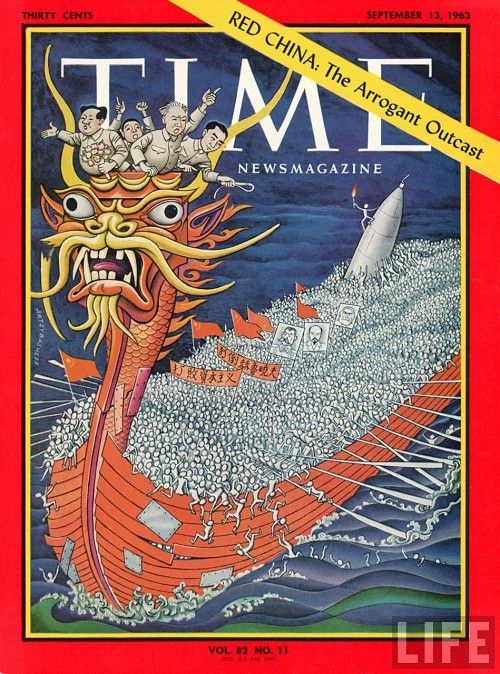
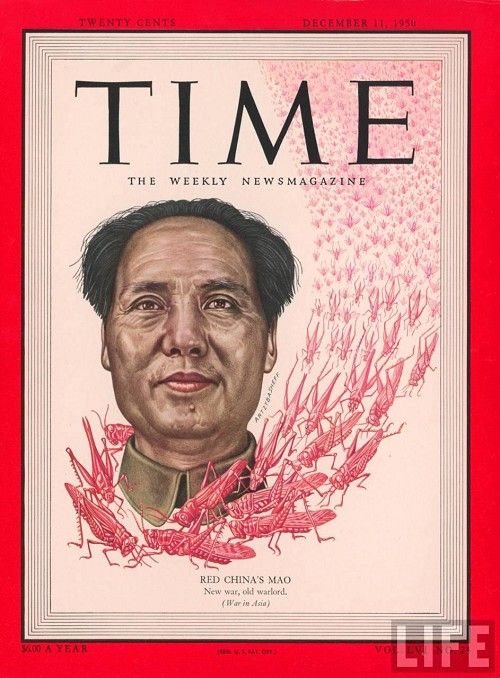
Let us call this discursive construct Neo-Borgian Yellow Peril, earlier images of which are exemplified by the two TIME covers below (locusts are 1950, teeming mass from 1963. From ChinaSMACK.) The mass, which in the early 20th century may have ridden very quickly on horses to invade America, but now ride very studiously on state-owned enterprises to invade world order. I am remiss in finding one particularly amazing image from the mid-1970s that depicts Mao as an aggregation of clamoring peasants and mandarins.

The Neo-Borgian Cloud has in fact been a trend in the visual representation of many Chinese events since the Olympics (see images below).The eeriness comes from a post-processing that invariably sharpens digital images, heightens color and smooths noise to convey that squeaky gleam of capitalist modernism - and a simultaneous proclivity for compositions that capture seemingly boundless duplication (ie terror of scale), immaculate repetition (ie terror of forced homogeneity) that projects the power of an authoritarian state.This is not to say that there is not a desire to project this very image of state power.
There is likely a good term for this. Perhaps it exists already in the fecund world of art criticism. I suggest militaristic hyper-modernism.


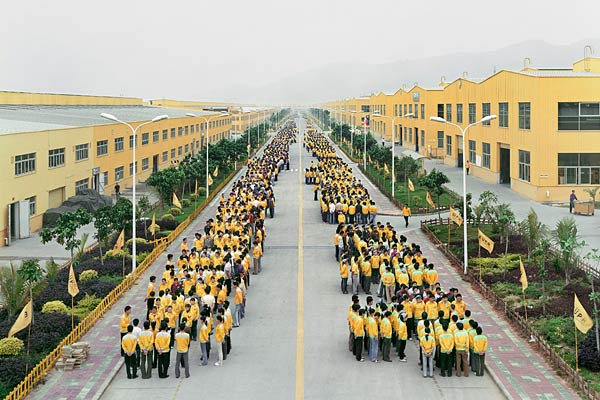
 From various sources, two shots from Olympic opening ceremonies, security exercise outside of the Bird's Nest, laborers outside of their factory and students preparing for exams. 


Read Full Post

Tuesday, January 4, 2011

Patents Per Million, Retraining Ant Colonies, "Cursory" Observation of Quantum Teleportation

Quick bits on technological innovation and more importantly technological imagination:

1. Two PRC related pieces on this recently much circulated - in the NYT, a piece analyzing a document put out in November by China's State Intellectual Property Office of China,  “National Patent Development Strategy (2011-2020)."  The major question is whether high-tech "innovation" oriented industrial policy will work, having not worked so well in Japan in recent years.  (Yet, recall that the Tigers - Japan, Taiwan, S. Korea - are the celebrated cases of successful industrial policy in their early rise.) Fun quote:
The Chinese patent strategy document is filled with metrics, right down to goals for patents owned per million people.
2. In a less meaty article in FP, Vivek Wadhwa also tackles the topic, his position summarized perhaps by the title "Chinese and Indian Entrepreneurs Are Eating America's Lunch." Citing his own previous research, he posits an interesting suggestion vis-a-vis the phenom of super low wages among college grads in China (the "ant colony"): its a result of crap training rather than a crap market:
India and China now graduate three to six times more engineers than does the United States. The quality of these engineers is, however, so poor that most are not fit to join the workforce; their system of rote learning handicaps those who do get jobs, so that it takes two to three years for them to achieve the same productivity as American graduates. As a result, significant proportions of China's engineering graduates end up working on factory floors; Indian industry has to spend large sums of money on retraining its employees, as my research team at Duke and Harvard learned.
3. And since this seems to have weirdly not made it on the parts of the China blogosphere I surf, some key WikiLeaks science and tech related wires are collected here. A key quote from a wire BRS forwarded, about Hefei's University of Science and Technology:
(COMMENT: A cursory walk through their labs seemed to indicate they had already succeeded in single-particle quantum teleportation and are now trying to conduct dual-particle quantum teleportation.)
WAHHH. Repeat: WAHHHH?

Read Full Post

Monday, June 14, 2010

Lu Xun X Jules Verne

Here's a link to a fab. piece at the China Beat - a group of academically minded wonks blogging on China coverage in US media, and nearly always fab. - on science fiction in the Chinese imaginary! A choice tidbit:

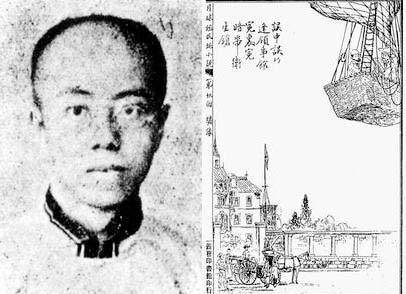
"A young Lu Xun, later the greatest writer of 20th century China, translated Jules Verne’s From the Earth to the Moon, and wrote an unforgettable slogan in his preface, “Leading the Chinese people forward begins with science fiction!” (导中国人群以进行,必自科学小说始)."

This is a pretty great Wikipedia entry on science fiction in China to accompany your thoughts. One of the first early 20th C. pieces was a vision of settlement on the moon colony...written in 1904. Illustration from the piece above.

Read Full Post

Thursday, June 4, 2009

Where are the 21 Most Wanted Students from Tiananmen Now?

Skipping right back into things today. Had been wondering whether there was a list compiling the 21 "Most Wanted" list after Tiananmen and where they are now, and it turns out there is quite a well done, comprehensive one done by the Human Rights in China group, compiled by one Stacy Mosher. The report - "Tiananmen's Most Wanted - Where are They Now?" - is at times heartening but strangely depressing to read. No 1, Wang Dan (pictured at the protests in 89 below), wrote a piece today that ran in the LA Times and HuffPo, and just finished up a PhD here in Cambridge last year. Most seem to have scattered, with some running "internet companies," at least one in a hedge fund, and two untraceable. Many of them, like Wang, have continued onto a life of activism abroad, and done quite well, particularly considering what they may have faced. Yet, reading it, I got the feeling that I suppose one might have when you go to a high school or college reunion, and nothing seems to fall in place, and you meet those bright young shooting stars that have hit the end of their burning light and fizzle out into mediocrity, and you suddenly see in a flash (cheaper yet, montage) all those wide-eyed days you wasted. 

As another note, the NY Times Lens blog surfaced a new picture of Tank Man.  The video (below), is mindblowing. I toyed with an entry tracing some of the various ways that Tank Man has gone viral, but the only entertaining and juicy bit I came across was a "Tank Man Tango" (described as "a memorial of dancing bodies") that went on this year in Australia to commemorate events. 

As child of the diaspora here, I primarily remember the set of events as a series of panicked faxes. The onset of the fax machine had been crucial in helping organize the protests, and getting a record of what had happened out of the country and out of sight of censors. (By one account, guards had been posted by all publicly available fax machines the morning of June 5.) I've yet to see [though I certainly haven't dug deeply] a good account that captures this dynamic though - there is not so much action, of course, in the clicking, whirring noises of a fax transmission. But to that nerve-wracking noise, many abroad received their handwritten notices sometime twenty years ago, far before the news stories broke, and anti-climactically felt the tide turn. 

Shepard Fairey's rendition of a picture by Ed Nachtrieb above. 


Read Full Post

Tuesday, March 17, 2009

Science and Chinese Secularism

Wanted to just post a few thoughts on the review of the Joseph Needham biography by Eric Hobsbawm in the London Review of Books. [Caution - I've not read Winchester's book or Needham's Science and Civilisation.]

Much of the review focused on the intellectual richness layered around the natural sciences during Needham's time and place - Cambridge, the 1930s. Not merely "A Man Who Loved China," Hobsbawn seems to say, Needham's project revolved around a dialectical materialism that had melded into materialism proper ("organic Marxism"), and a fascination with the seemingly casual monism of Chinese cosmologies. From the article:

The whole organism, [Needham] argued, could not be fully grasped at any one of the lower levels of increasing size and complexity – the molecular, macromolecular, cells, tissues etc – and new modes of behaviour emerged at each level which could not be interpreted adequately in terms of those below or at all, except in their relations. As he wrote in Order and Life, ‘The hierarchy of relations from the molecular structure of carbon to the equilibrium of the species and the ecological whole, will perhaps be the leading idea of the future.’ Process, hierarchy and interaction were the key to a reality that could be understood only as a complex whole.

And – though one would not discover this from Winchester’s book – thisview drew him towards the country and civilisation to which he devoted the rest of his life. China was the dialectical home of Yin and Yang, of an ‘extreme disinclination to separate spirit and matter’, as Needham put it, of a philosophy which, it has been well said, saw the cosmos as a vast symphony that composed itself and within which other lesser symphonies took shape.

[...] Needham loved and admired China and the Chinese but, oddly, his heart went out to the imperial past rather than to the revolutionary present to which he was committed and which he defended (though he seems to have become a critic of Mao’s policies in the 1970s, even before the death of the Great Helmsman). He felt at home not only with the Chinese view of nature so lovingly reconstructed in Science and Civilisation in China but with a civilisation based on morality without supernaturalism, a great culture where the doctrine of original sin didn’t prevail and a country where no priesthood had ever dominated.

[Above, an image from a chapter in Needham's book on "Civil Engineering and Nautics."]

This brought to mind a few posts I'd seen on one of the many interesting SSRN blogs, "The Immanent Frame" (which largely is an expanding set of commentary revolving around Charles Taylor's The Secular Age. Disenchanting, ey?). Three posts by Richard Madsen (UCSD, Sociology) on Chinese secularism were very interesting , but I wasn't quite sure what to make of them (all drawn from a forthcoming chapter in a SSRN edited volume.) Examples of statements that I didn't feel like I agreed with but didn't have a basis for objecting to: 

Discerning the religious spirit of secular states in Asia
"But the secular form of Asian political institutions often masks a religious spirit. Some examples: Japan has a secular constitution, but many of its government leaders have felt compelled to pray for the spirits of the war dead at the Yasakuni shrine." 

Embedded religion in Asia

"However, this dynamism is of a different kind than that found in the United 

States, and it cannot be explained in terms of the narrative Taylor uses in the North Atlantic world.

 Asian religious developments are often misread by both Western observers and Asian scholars trained in the Western social sciences. When Western scholars have looked for religion in Asian societies, they have often looked for it in the form of private faith. But in most Asian societies, much of religion is neither private nor faith."

Hybrid consciousness or purified religion
"Taiwan’s state has taken a secular turn with democratization, but it still relies on religion to provide public stability and generate international recognition."

My quips probably lie with the analytical categories at play, and their usefulness - measuring degrees of embeddedness also, in some way or another, forces one to gauge the veracity and typology of belief. Embeddedness, in this context, may be a way of expressing what Needham had seen - a tendency not to see "spirit and matter" as radically separated, thus rendering secularism a somewhat sterile concept, a matter of institutions and practices rather than belief. Food for thought, in either case. 

Other articles of interest:
"The Public Sphere, Civil Society, and Moral Community: A Research Agenda for Contemporary China Studies", Modern China 19:10 (April, 1993).

"The Spiritual Crisis of China's Intellectuals" in Ezra Vogel and Deborah Davis, ed. The Social Consequences of the Chinese Reforms (Harvard University, 1991)

Also, I had seen that Du Shu magazine (Readings) had, in their June-August 1995 editions, played out a series of essays under the title "Why Not Collectively Build a Spiritual Homeland?" Perhaps of interest. 

Read Full Post