Showing posts with label visual culture. Show all posts

Thursday, February 10, 2011

Immaculate Hoardes: Visual Correlatives of Swarm Fear

A quick response to a post on [The China Beat] that caught a trend I've been meaning to post on for a while. Writes one T.S. Mullaney about Foreign Policy's recent "Rise of the Hans" feature:
Whoever at Foreign Policy thought of this image—in particular, thought of using the metaphor of clones—captured the essence of Kotkin’s argument flawlessly: the Han, we are meant to believe, is a singular mass of physically, politically, ideologically, socially, culturally, and linguistically indistinguishable replicas, one that brings to mind the clone troopers of Kamino in Star Wars or, perhaps, hive-like, sci-fi adversaries, such as the “Buggers” in Orson Scott Card’s Ender’s Trilogy, the Arachnids of planet Klendathu in Robert Heinlen’s Starship Troopers (who, incidentally, was writing in the aftermath of the Korean War and was also fascinated by the racist idea of an ego-less, self-less, and homogenous Asian adversary), or the Borg of Star Trek (a tendency that some commentators have explicitly used to refer to the PRC—something that one of the co-founders of China Beat criticized in a piece that appeared in Foreign Policy itself last year). Kotkin omits, or perhaps does not know, that the Han is one of the least homogenous groups history has ever known: contained within its ranks are people who literally cannot understand each other’s spoken languages and people who—let’s just be basic about this—exhibit the same sort of diversity of worldviews as one would expect to find among a group of one billion people anywhere on earth.
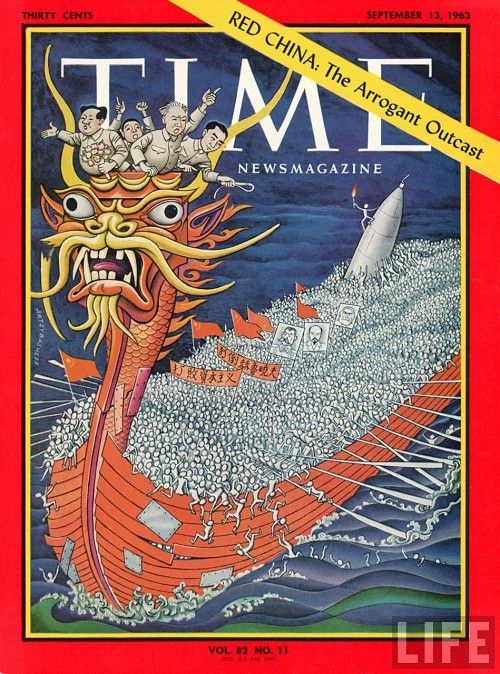
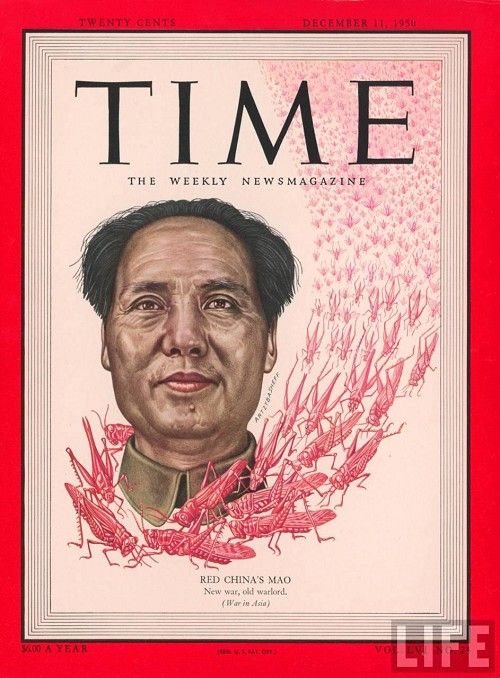
Let us call this discursive construct Neo-Borgian Yellow Peril, earlier images of which are exemplified by the two TIME covers below (locusts are 1950, teeming mass from 1963. From ChinaSMACK.) The mass, which in the early 20th century may have ridden very quickly on horses to invade America, but now ride very studiously on state-owned enterprises to invade world order. I am remiss in finding one particularly amazing image from the mid-1970s that depicts Mao as an aggregation of clamoring peasants and mandarins.

The Neo-Borgian Cloud has in fact been a trend in the visual representation of many Chinese events since the Olympics (see images below).The eeriness comes from a post-processing that invariably sharpens digital images, heightens color and smooths noise to convey that squeaky gleam of capitalist modernism - and a simultaneous proclivity for compositions that capture seemingly boundless duplication (ie terror of scale), immaculate repetition (ie terror of forced homogeneity) that projects the power of an authoritarian state.This is not to say that there is not a desire to project this very image of state power.
There is likely a good term for this. Perhaps it exists already in the fecund world of art criticism. I suggest militaristic hyper-modernism.


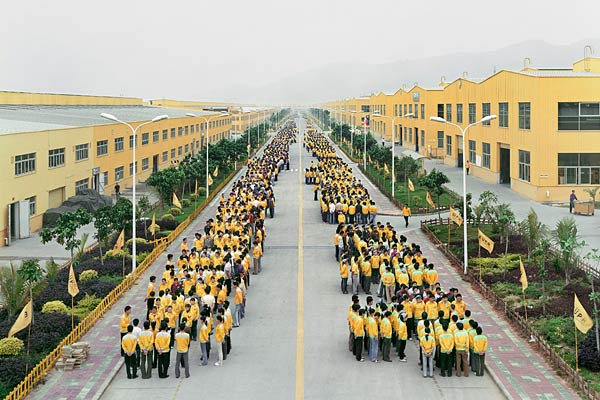
 From various sources, two shots from Olympic opening ceremonies, security exercise outside of the Bird's Nest, laborers outside of their factory and students preparing for exams. 


Read Full Post

Tuesday, September 8, 2009

Psychological Returns on Stamp Collecting in China...or Not.


Sometime last month I saw the following study on an SSRN's (the Social Science Research Network - where academic working papers go to procreate) Cognitive Science Network newsletter: "Does Psychological Return Matter? Evidence from China Stamp Market"

ABSTRACT: Previous literature has challenged the traditional claim that collectibles have high returns and expensive collectibles tend to return more. However, only financial returns were examined previously while psychological returns was completely overlooked, which may result in underestimation of returns on collectibles. This paper examines the returns from investment in China stamp market and the existence of psychological returns. The empirical results suggest that stamp returns in China stamp market are very dispersive and expensive stamps tend to have a low return. Potential psychological returns generators have negative effects on financial return of stamps, which implies the existence of psychological return.
After fond flashbacks to trolling around moving sales in St. Louis through childhood (dusty stamp collection were a staple of the event), the first few questions in my mind were
  1. Why stamp collecting? Don't behavioral economists at Peking University have something more...interesting to study? Like pornography or blood donations ?
  2. What are those most expensive stamps in China these depressed collectors are staring at?
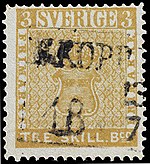
So towards an answer this article in City Weekend Beijing describes the Yuetan Stamp and Coin Market in Beijing. Pictures above are: the one and two cent Mauritius stamps that sold for $3.8 million each in 1992. The rarest stamp in the world - the Tre Skilling Banco Yellow, first stamp of Sweden and one of a kind and sold for $2.3 million in 1996. The most expensive stamp of China was a 19th Century Qing stamp - "One-Yuan Red Revenue Surcharged Small Issue" (Red, Top). A "1897 Three Cents Red Revenue stamp" going to auction later this month may be the next catch though.

PS. Most predictable/hilarious instantiation of the state in the aforementioned study: "special stamps” (including "less serious topics, such as folklores, flowers, birds, vegetation, architectures as well as paintings of famous artists") have a significantly higher psychological and monetary return than "memorial stamps" (which cover political themes such as "the 50th anniversary of the foundation of the People’s Liberation Army, the victory of the Resistance War against Japanese Invasion and the opening of the 17th National Congress of CPC.")

Read Full Post